|
|
<< Click to show the Table of Contents >> ASP: EXAMPLE 1. BASIC CALCULATION WITH THREE TRANSMITTERS WITHOUT SATURATION |


|
|
|
<< Click to show the Table of Contents >> ASP: EXAMPLE 1. BASIC CALCULATION WITH THREE TRANSMITTERS WITHOUT SATURATION |
|
|
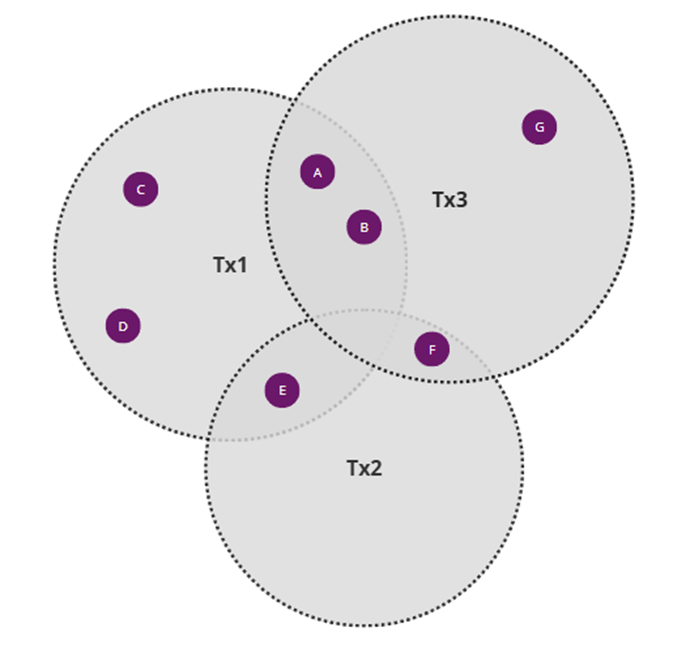
An example scenario is presented with 3 transmitters, where the calculation magnitude is units of the point layer (A, B, C, D, E, F, G), with one unit at each point, the weight is equal to 1, the minimum and maximum are calculated automatically (in this example, the minimum is set to 0 and the maximum to 5), and the saturation is infinite. The coverage map is as follows:
The process in this scenario would be as described below.
ITERATION 1 Step 1: Analyze coverage Target coverage: Points A, B, C, D, E, F, G (7 units). Tx1 coverage: Points A, B, C, D, E (5 units). Tx2 coverage: Points E, F (2 units). Tx3 coverage: Points A, B, F, G (4 units). Step 2: Score and choose the prioritized transmitter Since Tx1 covers 5 units, the algorithm sets the maximum equal to 5, so Tx1 obtains a score of 5/5 = 1. Since Tx2 covers 2 units, out of the maximum of 5 units defined above, it obtains a score of 2/5 = 0.4. Since Tx3 covers 4 units, out of the maximum of 5 units defined above, it gets a score of 4/5 = 0.8. Factors that may modify the score: •Saturation is infinite, so no transmitter exceeds it, and therefore the scores do not change. •The weight of the layer for the units is 1, so the scores do not change. •By default, the multipliers are set to 1 and the additions to 0, so the scores do not change. •By default, there are no transmitters with manually set priority or marked as "always prioritize", so the scores do not change. Tx1 is chosen because it has the highest score. Step 3: Remove coverage provided by the chosen transmitter from the target coverage Since Tx1 covered points A, B, C, D, and E, the coverage of the other transmitters is updated by removing those points.
ITERATION 2 Step 1: Analyze coverage Target coverage: Points A, B, C, D, E, F, G (7 units). Tx2 coverage: Point F (1 unit). Tx3 coverage: Points F, G (2 units). Step 2: Score and choose the prioritized transmitter Tx2 covers 1 unit, out of the maximum of 5 units defined above, and obtains a score of 1/5 = 0.2. Tx3 covers 2 units, out of the maximum of 5 units defined above, and obtains a score of 2/5 = 0.4. There are no factors that modify this score. Tx3 is chosen because it has the highest score. Step 3: Remove coverage provided by the chosen transmitter from the target coverage Points F and G covered by Tx3 are removed.
ITERATION 3 Step 1: Analyze coverage Target coverage: none (0 units). Tx2 coverage: none (0 units). Step 2: Score and choose the prioritized transmitter Tx2 covers 0 units, out of the maximum of 5 units defined above, and obtains a score of 0/5 = 0. There are no factors that modify this score. Tx2 is selected.
FINAL RESULT (SORTED BY SCORE) Tx1 covers 5 units and obtains a score of 1. Tx3 covers 2 units and obtains a score of 0.4. Tx2 covers 0 units and obtains a score of 0.
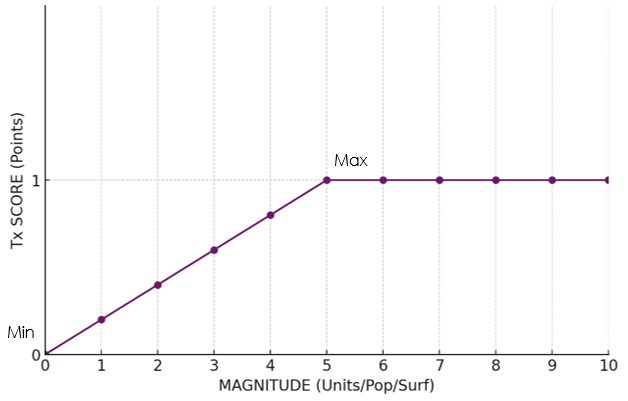
Below is an image representing the calculation of possible scores taking into account the aforementioned priority controls. The minimum score is 0, so from there a transmitter can begin to earn points, and the maximum score is achieved when a transmitter reaches the maximum number of transmissions.
|